If you have an electronic device that is in need of some repair, and you're willing to do the repair yourself, use this forum for advice from other electronics experts.
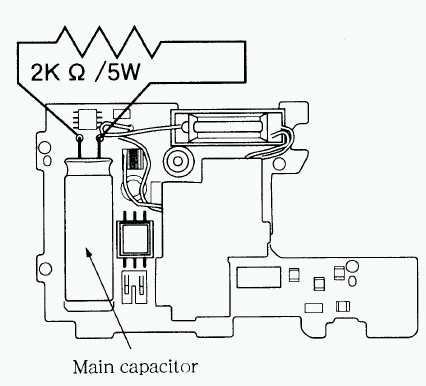
I'm attempting to fix my Nikon Coolpix 800 digital camera. I found a service manual online that describes how to take it apart. After you remove the front panel, they tell you to discharge the main capacitor. They don't give you any actual instructions on how to do this, they just give you the following pic...
I assume this means, get a 2k ohm / 5w resistor and hold it across the terminals of the capacitor. Looking through my box of resistors, they're all 1/2 watt or 1/4 watt and I don't have exactly 2k. So, any suggestions? I don't know how exact of a match the resistor needs to be, but I'm assuming the wattage thing is an issue.
Rob www.hifi-remote.com Please don't PM me with remote questions, post them in the forums so all the experts can help!
First, you don't want your fingers on the leads when you touch it. Clip leads are usually a good idea (generally 200 - 400 volts are present).
Lower resistance values require the higher wattage values. You don't direct short due to arcing issues. Higher value resistors just take longer to discharge but you can use lower wattages.
I have a 3K two watt that I use. I pop into the top of the stacking banana jacks on my meter so I can use the insulated meter probes for discharging capacitors (and watch the voltage drop to safe levels).
Just call me Zaphod (or Steve) --- I never should have started using numbers in a screen name but I just can't stop now.
Given that I don't have any resistors as high as 2 watts, can I use a higher ohm resistor that's only 1/2 or 1/4 watt, and if so, what resistance would you recommend? Or, can I use my multimeter in some way instead?
Ha, I knew I had used a powered resistor for the original "Dan Classic" JP1 box, and I just found the extras. They are 2w but they're only 2 ohm, so not much use.
I just checked the Radio Shack web site and they don't have anything with high watts.
Rob www.hifi-remote.com Please don't PM me with remote questions, post them in the forums so all the experts can help!
Since the initial voltage is already there (not a function of resistance) the wattage is inverse linear with resistance. So if 2K 5W is OK, 20K 0.5W is also OK (ten times longer to discharge, but I doubt it is very long even that way).
The math is pretty simple:
I = V / R
W = V * I
W = V * V / R
V = sqrt( W * R )
So a 20K .5W resistor (or 2K 5W) would be out of spec if the voltage is over 100V. A 2K .5W resistor would be out of spec if the voltage is over 32V.
I like that idea of pre connecting the resistor across the meter and watching the voltage go down.
If it's really 200 to 400 volts, then maybe you want to go with even more than 20K. I would think their suggestion puts less than 5W through the 5W resistor, but if it is significantly over 100V they're putting more than 5W through the 5W resistor for the initial instant. That may be OK (because it is for so little time). Putting proprortionally more than .5W through a .5W resistor for ten times longer wouldn't be OK.
Thanks to both of you for the advice, impecible as always. When I measured the voltage before I started it showed 250v (not bad for 4 AA batteries). All of my big resistors are 1/4 w, so I figured I needed at least 40k and the best I had was 100k. It took about 10 seconds to get down from 250v to a low-ish voltage and about 30 seconds total to completely drain.
Now to see if I can find the thing that's rattling and obscuring the lens.
Rob www.hifi-remote.com Please don't PM me with remote questions, post them in the forums so all the experts can help!
Oh M'Lord, if John didn't remember his physics lessons and Zaphod had no experience, Rob could've been fried! My accident prone husband once flew across the room fooling with capacitor in an amplifier
Happy Holidays to all the experts & helpers and forum members!
Liz Tweeking 8910, HTPro/9811, C7-7800, 6131o, 6131n, AtlasOCAP-1056B01, RCA-RCRP05B and enjoying the ride
Although the Voltage is/was rather high, I doubt there was sufficient capacity there to actually "fry" poor Robman (voltage does not kill, current does). At worst he could have damaged the camera's innards and caused a bit of a startling spark.
Remotes: OFA XSight Touch, AR XSight Touch TVs: LG 65" Smart LED TV; Samsung QN850BF Series - 8K UHD Neo QLED LCD TV RCVR: Onkyo TX-SR875; Integra DTR 40.3 DVD/VCR: Pioneer DV-400VK (multi-region DVD), Sony BDP-S350 (Blu-ray), Toshiba HD-A3 (HD-DVD), Panasonic AG-W1 (Multi-system VCR); Laserdisc: Pioneer CLD-D704. Amazon Firestick tape deck: Pioneer CT 1380WR (double cassette deck) (But I still have to get up for my beer)